Edge AI for Computer Vision: Bringing Intelligence Closer to the Data
Hi, I am Btere! I am a software engineer, and a technical writer in the semiconductor industry. I write articles on software and hardware products, tools use to move innovation forward! Likewise, I love pitching, demos and presentation on different tools like Python, AI, edge AI, Docker, tinyml, software development and deployment. Furthermore, I contribute to projects that add values to life, and get paid doing that!
Edge AI for Computer Vision: Bringing Intelligence Closer to the Data
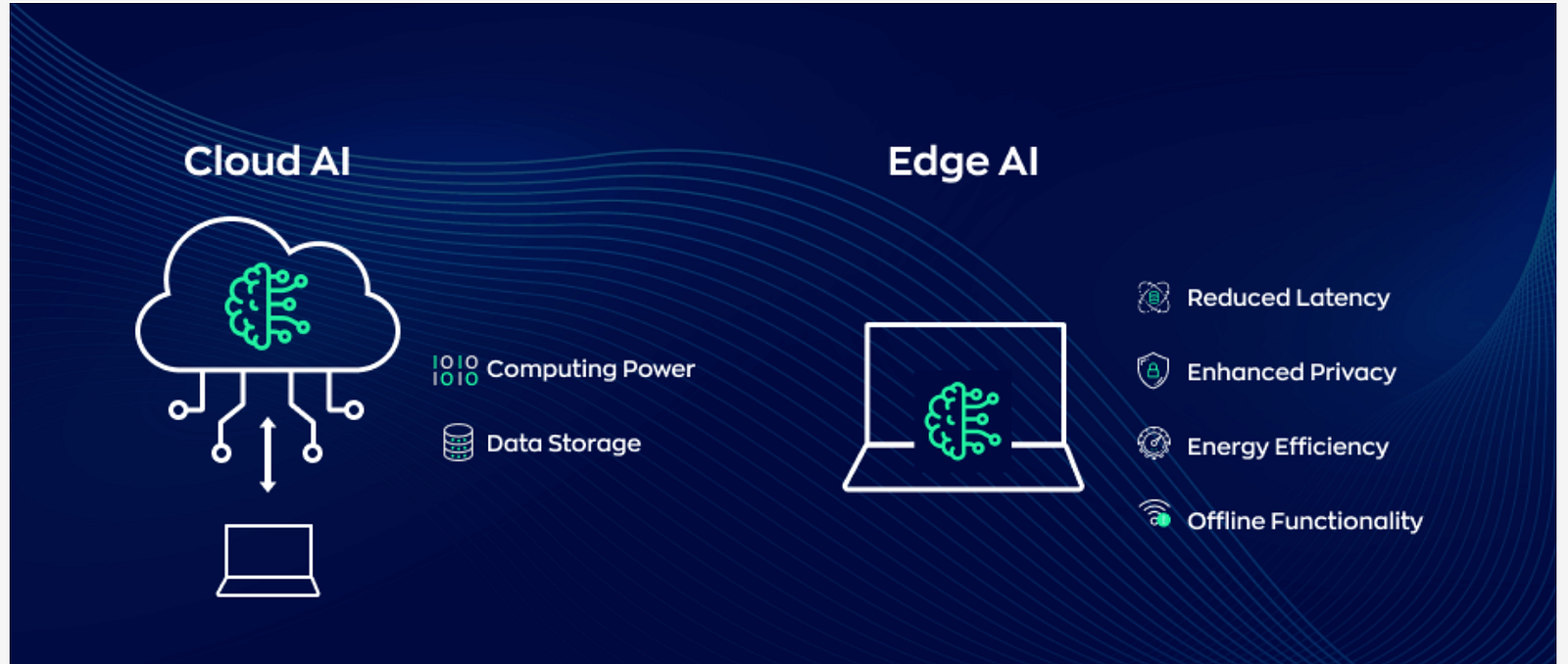
Edge AI is changing the way we deploy and use AI models. Instead of relying on cloud servers for processing, AI models can now run directly on devices like drones, smart cameras, robots, and even smartphones. This shift has huge implications for real-time decision-making, privacy, and efficiency.
What is Edge AI?
Edge AI refers to running AI models on edge devices, which are physically close to where data is generated. By processing data locally, edge devices reduce latency, protect privacy, and maintain functionality even without an internet connection.
Why Edge AI Matters in AI
Computer vision applications such as object detection, activity recognition, or surveillance produce enormous volumes of data. Sending this data to the cloud is slow, expensive, and bandwidth-intensive. Edge AI solves these issues by:
Providing near-instantaneous decisions
Keeping sensitive data private
Sending only actionable insights instead of raw data
Maintaining offline functionality
Edge Devices: Drones and Smart Cameras
Drones
Drones are a key application for Edge AI. They are used for surveillance, agriculture monitoring, search and rescue, and infrastructure inspection. Typical drone hardware includes:
Sensors: RGB cameras, depth sensors, LiDAR, infrared cameras.
Processing hardware: System-on-Chip (SoC) like NVIDIA Jetson Nano/Xavier, Qualcomm Snapdragon, or lightweight MCUs for simpler tasks.
Memory & storage: 2–16GB RAM, small NVMe or SD card storage for caching frames.
Smart Cameras
Smart cameras are used in security, retail analytics, traffic monitoring, and industrial safety. They typically include:
Sensors: High-resolution RGB cameras, infrared sensors for night vision, depth sensors
Processing hardware: AI-enabled SoCs like Intel Movidius Myriad or Ambarella CVflow, or MCU/FPGA hybrids
Memory & storage: 1–4GB RAM, storage for temporary frames and logs
QA and Data Quality Considerations
Deploying CV models on edge devices introduces unique QA challenges:
Model accuracy under constraints: Lightweight or quantized models must maintain accuracy.
Performance testing: Latency, frame processing rate (FPS), CPU/GPU/memory usage must be monitored.
Robustness across environments: Devices operate in diverse lighting, weather, and motion conditions.
Streaming and real-time monitoring: Ensuring video streams are processed without frame drops.
Data drift monitoring: Models may degrade if real-world data diverges from training data.
Integration testing: Edge AI systems must be tested with sensors, networks, and decision-making pipelines.
Challenges in Edge AI for CV
Hardware limitations: Limited compute power, memory, and energy
Model optimization: Pruning, quantization, knowledge distillation
Update management: Deploying new models to multiple devices
Testing at scale: Simulating real-world environments for QA
Real-time constraints: Balancing inference speed, streaming, and battery life
The Future of Edge AI in CV
Specialized hardware like NVIDIA Jetson, Google Coral, and Apple Neural Engine is making high-performing CV models on edge devices easier. Combined with robust QA practices, Edge AI enables:
Smarter, more autonomous devices
Safer and faster decision-making
Reduced reliance on cloud infrastructure
Greater resilience in real-world deployments
Key Takeaway
Edge AI for computer vision represents a paradigm shift. Running models directly on drones, cameras, and other devices offers speed, privacy, and resilience. Together, Edge AI and strong QA practices can unlock the next generation of intelligent systems.


